


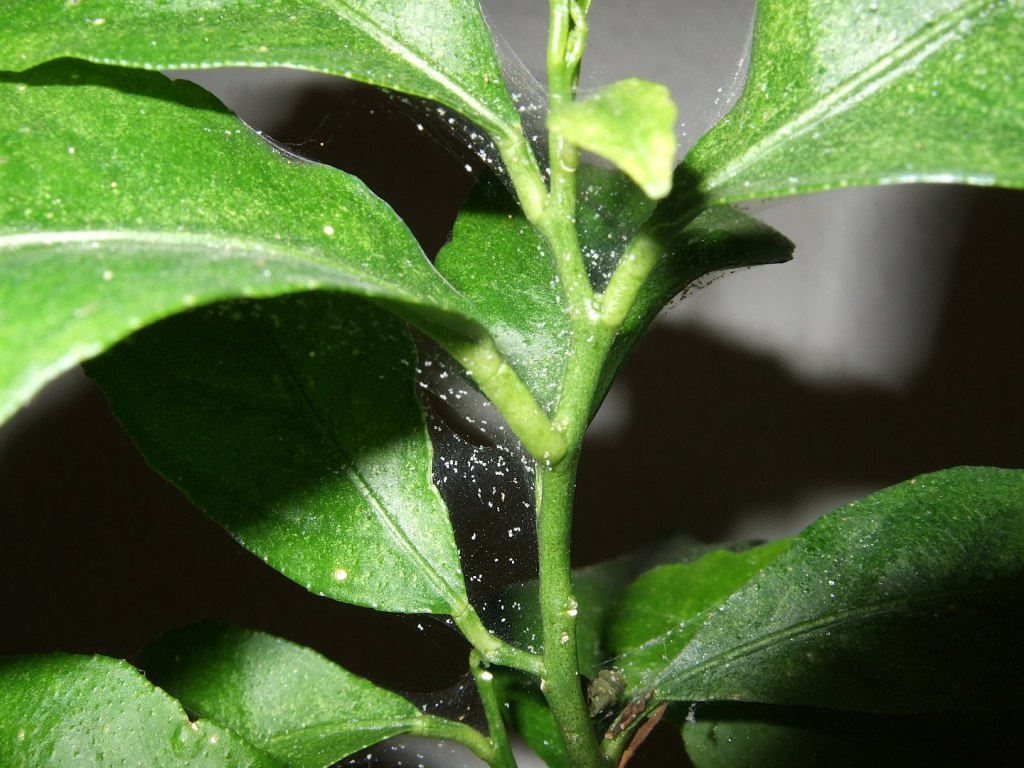
(picture of spider mites courtesy of wikipedia)
If you are an aroid fan, these mites are definitely no stranger to you. I have been through periods of mites scare during the wet humid months and they are still a problem for me. And I have always been too quick to get rid of them so much so I never got round to taking a good picture. They can easily scar their leafs or destroy your favourite plant in a matter of days.
Here’s some background about spider mites before we dived in. Understanding these bugs is one good way for us to protect our plants. They are labelled as a type of arachnid, relatives of spiders, ticks and scorpions, and live in colonies, mostly on the underside of leaves. They especially love to feed on those aroids with thick, juicy petiole and feed by piercing your leaves and sucking off the plant fluids. The alocasias are one of its favourite targets but the hardy philodendrons are not spared either. Exotic Philodendrons especially those with thick fleshy petiole like the Philodendron Nangaritense and Deflux, and the more common ones like the Imperial red are similarly bitten.
Environment
They thrive in a dusty area and is active when the humidity is a lot higher. They usually attack plants that have higher levels of nitrogen, phosphorous and carbohydrates in their leaves. For me, this always means they are around when my plants are thriving and healthy.
Signs
If you are lucky, you will be able to see some of these signs before the infestations set in.


Tiny yellow or brown dots near the midrib or leaf edges
The tiny dots are feeding marks left by the spider mites as they pierced the leaf. As the feeding continues usually as a colony, the leaves start to turn yellow and drop off in the end.
Webbing
If you see webbing between your leaves, it is a tell-tale sign they are there. Look closely at the leaves especially between the folds of the leaves and their undersides, and you may see a colony of red mites moving about.


Sticky nectar secretes by Philodendrons
Another obvious sign is the sticky secretions that only appear on the leaves of the philodendron. They have this special ability to secrete the nectar on their leaf blades, petiole and inflorescence. So far, I haven’t once seen the nectar secretions without the spider mites just close by. The philos secrete these nectars to attract nearby ants to come to its rescue and feed on the mites. So, go easy on the ant baits that you set up in the house or there will not be any ants left to come help.
Controlling spider mites the organic way
This is not an advertorial and I do not receive a fee for recommending any of the products in this post.
- Shower plants
Bring the plant to your bathroom and give the leaves a good shower every time you water them. Any spider mites will be washed off.
- Tab with rubbing alcohol
You can also soak a little kitchen paper with rubbing alcohol or isopropyl alcohol to gently tab on them. This is a tedious method but very thorough way. Any contact with the alcohol will kill them and so they will not hop to nearby plants. The last thing you will want is to brush them off to other nearby plants.
- Use systematic (root uptake) pesticide like Starkle G.
Although not exactly organic, Starkle G is harmless to us and our pets. These pesticides will make your plant poisonous to the mites . And any feeding on the plant will in turn kill them. This is by far the best method for me because what you want really is prevention so there aren’t any ugly leaf marks left by the feeding.

- Neem Oil
You can also use organic neem oil to spray your foliage and smother the mites. Neem oil is a road-spectrum organic herbal pesticide and repellent. The neem oil spray from Green Spade is one of the better ones and doesn’t burn as much. But again, I usually only use this as a last resort and only on the thicker leaves because you may miss them even when you do a very thorough foliage spray. Also, neem oil even when diluted can cause leaf burns. Remember to do this only in the early mornings or during the evenings when the weather is a lot cooler. - Homemade Insecticidal soap
It is the fatty oils in the soap that kills the mites. So the Ingredients you will need are just organic soap and water. Do not use just any soap because the strong chemicals may be harmful to your plants. Just mix 1 tablespoon of castile soap with 1 litre of water and spray or wipe the leaves of your plant. You can use Dr. Bronner’s pure castile soap. I use this because it has been widely tested by plant owners world -wide and safe. If you are in Singapore, you can find this in Watsons. The peppermint range is fine because it has pure peppermint oil in it as well. Some plant owners will add a little rubbing alcohol/isopropyl alcohol in it, but that is really optional. This is a contact insecticide so spray only when you see the mites. Some times, when you don’t see them, it could also be effective because the solution kills the dormant eggs as well. Remember to spray stem and under the leaves where the mites like to hide. And try to spray only during cooler times of the day so it doesn’t evaporates before it can be of use and remember to patch test this on your plant before spraying just in case it is too strong.
- Always try to wipe down your plants.
Keeping them clean keep the mites at bay. Also, set the humidifier lower. Spider mites thrive in high humidity and this usually attracts them to feed on the plants, although a very low humidity and dusty environment encourages them to reproduce a lot quicker.
- Other chemical sprays
I am currently testing out Zagro Abamectin available at Far East Flora which is a broad spectrum systemic insecticide that attacks the nervous system of insects and mites. This a very strong chemical spray that kills through contact as well as uproot intake of the plant and is used on plants with natural protection or really just very elusive. One of the last resorts for me because it is a chemical spray and is often harmful to us on contact and not advisable for indoor plants around us.
I HOPE YOU’VE ENJOYED MY POST HERE ON PROTECTING YOUR HOUSEPLANTS FROM SPIDER MITES. IF YOU HAVE ANY THOUGHTS YOU LIKE TO SHARE, PLEASE COMMENT BELOW OR JUST DM ME ON INSTAGRAM @plant_folksg
I WILL LOVE TO HEAR ANY OTHER WAYS YOU MAY HAVE ON PROTECTING YOUR PLANTS FROM THESE PESTS.